Pages

Showing posts with label Europe. Show all posts

Friday, 16 January 2015

What's in the Headlines?


Rabbi urges Europe to arm Jewish communities

Rabbi Menachem Margolin, the director of the European Jewish Association, the largest Jewish federation in Europe, has called on the European governments to allow synagogues, kosher shops and Jewish property to be authorised to carry guns in response to fears of rising anti-Semitism.

“The Paris attacks, as well as the many challenges and threats which have been presented to the European Jewish community in recent years, have revealed the urgent need to stop talking and start acting,” says a letter written this week by Rabbi Menachem Margolin

Newsweek magazine’s Catherine Phillips asked for clarification from Margolin. The Rabbi told her that as many people within the Jewish community as possible should carry weapons. He told her that a license to carry would provide people in the Jewish community with a sense of security that is sorely lacking in Europe, particularly in light of recent events.

One of those critical of Margolin’s proposal is Rabbi Abraham Cooper, associate dean of the Simon Wiesenthal Center, who said that a handgun would have been of little value in the Paris shootings:
As to personally being armed, such a move could help when a Jewish person is threatened by thugs, but won’t help if — God forbid — Charlie-type terror attacks are launched.

A delegation from the European Jewish Congress spoke to EU foreign policy Chief Federica Mogherini on Wednesday, calling on Brussels to create a pan-European body to combat anti-Semitism.

“Now more than ever, the European Union needs to create a position and organization specifically geared toward finding long-lasting solutions for anti-Semitism and other forms of racism,” EJC president Dr Moshe Kantor said.

Kantor added that it is “incumbent on the European Union to urgently place combating anti-Semitism as one of its highest priorities because this is a hatred that transcends borders and cannot be dealt with by any single nation on its own.”

Friday, 26 September 2014

What's in the Headlines?


Drug Trafficking and Prostitution boost Spain’s GDP by €9 billion

Spain has decided to include illegal activities such as drug trafficking and prostitution into the country’s gross domestic product. On Thursday the country lifted its GDP figures for 2013 by €26.19 billion to €1.05 trillion thanks to the inclusion of such activities and also from contributions of research and development and military armament. 0.35% of Spain’s newly calculated GDP comes from prostitution and 0.50% of it from drug trafficking, amounting to €9 billion, and reducing
the country’s debt ratio of 98.9 percent to 96.4 percent.

The Spanish national statistics agency, the INE, calculated that in 2011 Spain was home to 300,000 prostitutes and used this number to calculate how much they made in consultation with sex clubs. The quantity of drugs seized in 2014 was estimated as a percentage of the whole illegal drugs industry and used to evaluate it. According to figures from the Government Delegation of National Plan on Drugs cannabis is the most popular substance used in Spain with figures reaching 27.4 percent, followed by powder cocaine at 8.8 percent.

The changes to Spain's GDP are a result of new EU reporting requirements, meaning countries now have to provide details on what proportion of gross domestic product is based on activities as diverse as people smuggling, contraband cigarettes and prostitution.


France refused to provide data on prostitution, arguing that it was not necessarily carried out willingly. Sweden, where paying for sex is a crime, also refused. Italy on Monday published its own revised GDP figure, which rose by 3.8 percent when the new norms were applied. Britain has estimated that counting illegal activities could add €12.3 billion to its production, just below one percent of its GDP for 2013.

Monday, 15 September 2014

What's in the Headlines?


Migrant death toll rises on route from Libya to Europe

Many migrants leaving Africa to escape instability have drowned near Tajoura, east of Tripoli. The migrants were attempting to cross the Mediterranean to reach safety in Europe.

Navy spokesman Ayub Qassem said 26 people had been rescued after the vessel, carrying 250 went down. Qassem said most of the migrants were Africans and many were women. The use of poorly crafted wooden boats overloaded with desperate migrants have resulted in hundreds of deaths. This most recent tragedy comes just weeks after a vessel carrying migrants sank on the route from Libya to Italy, killing 100 people. Two more migrant vessels have been reported to have sunk in the past few weeks.


Human traffickers are using the unstable atmosphere in Africa to exploit those who seek asylum in Europe. The underequipped Libyan coastguard is struggling to deal with the problem and have few resources to search for survivors. They are currently using fishing boats and tugs borrowed from the oil ministry. 

Monday, 8 September 2014

What's in the Headlines?


Ukraine’s ceasefire is close to collapsing 

Shelling and gun fire has erupted in Mariupol and city of Donetsk in eastern Ukraine on Sunday night. This comes after a Friday ceasefire agreement was reached in Minsk. More than 2,600 people have been killed since the conflict began in April. A battalion of Ukrainian fighters said that Grad rockets had been fired at its positions destroying at least one vehicle and setting a fuel station ablaze.

Separatist forces and Russian troops have been accused of targeting Ukrainian tanks just outside of the city. Both sides have blamed each other for violating the ceasefire. Tensions remain high in the region as Russian troops remain in the area, a claim supported by NATO. Military officials in Kiev speculate that the number of Russian troops still in Ukraine could be between 3,000 and 4,000.


On Saturday exercise Steadfast Javelin II was staged in Latvia. The exercise simulates a deployment of NATO forces and equipment in a crisis situation. NATO members and allied eastern European nations fear Russia could invade other Baltic countries and use the defence of Russian speakers a justification, like we saw in Crimea. In total, 2,000 soldiers from nine nations will be involved and further exercises will be carried out across five countries - Germany, Estonia, Latvia, Lithuania and Poland. Further exercises in Germany, Norway, Ukraine, and Poland are scheduled for autumn.

Friday, 5 September 2014

NATO Summit 2014


Newport, the third-biggest city in Wales, is this year’s home for the annual NATO summit. Barack Obama, David Cameron and 59 other world leaders will convene in Newport’s Celtic Manor Hotel.
Anti-war protesters were welcomed by the police and were appreciated for carrying out mostly peaceful demonstrations. Memories of violence from previous NATO summits meant police were not taking any chances. Metal barriers were used to prevent protesters from reaching the Celtic Manor resort, and police greatly outnumbered protesters.

An armoured personnel carrier, a tank and an F-35 life-sized model were on display in the Celtic Manor golf resort. A Ministry of Defence (MoD) spokesman said that the displays were intended to showcase British defence capability as well as the country's defence industry.

Eastern European NATO members, including Poland, have appealed to NATO to permanently station troops on their territory to deter possible Russian attack. But not all NATO members agreed with the idea. This is thought to be because of expenses involved and this move would likely breach a 1997 agreement with Russia under which NATO committed to not permanently station large combat forces close to the Russian border. Leaders have agree instead to provide caches of military equipment and resources, in eastern NATO countries with bases ready to receive the rapid reaction force in times needed.

NATO's top official accused Moscow on Thursday of attacking Ukraine, and escalating the conflict. France is to suspend delivery of a state-of-the-art Mistral warship to Russia in protest at Moscow's continued role in unrest in eastern Ukraine. Speaking on the side lines of a NATO summit in Wales, Poroshenko said the ceasefire would be conditional on a planned meeting going ahead in Minsk on Friday of envoys from Ukraine, Russia and Europe's OSCE security watchdog. Poroshenko "At 1400 local time (12:00 noon BST on Friday), provided the (Minsk) meeting takes place, I will call on the General Staff to set up a bilateral ceasefire and we hope that the implementation of the peace plan will begin tomorrow," he told reporters. Oleg Tsaryov, a senior rebel official “in the past we had some ceasefire agreements Poroshenko didn't honour"

Prime Minister David Cameron has warned fellow NATO leaders that they must not pay the requested ransoms to terrorist kidnappers. It comes after he said Britain will not pay a ransom for the UK hostage who Islamic State extremists (IS) are threatening to kill. IS are threatening the life of British aid worker David Cawthorne Haines who has been taken hostage. Nato Secretary General Anders Fogh Rasmussen said: "I do believe the international community as a whole has an obligation to stop the Islamic State from advancing further."


How to stabilize Afghanistan when NATO forces leave at the year's end will also be up for discussion at the summit. Officials have commented that NATO leaders will set up a "spearhead" rapid reaction force, potentially including several thousand troops, that could be sent to a hotspot in as little as two days. 

Monday, 1 September 2014

What's in the Headlines?


Western action against the Islamic State continues

Shia Turkomans living in the Iraqi city of Amirli have been cut off from food and water for nearly two months by Islamic State militants. The city has fortified its position and has been fighting off Islamic State forces since June. The US delivered aid to Amirli and conducted air strikes in the surrounding area hitting three Humvee patrol vehicles, a tank and an armed vehicle held by militants in addition to a checkpoint held by IS. The air strikes cleared a route in which Iraqi troops rescued 12,000 residents of the city.

Tony Abbott, the Prime Minister of Australia, has agreed to assist the US in delivering weapons and humanitarian aid to Kurdish fighters in Iraq. Australia will join Canada, Italy, France, and the United Kingdom in a multinational effort to curb the advance of Islamic State fighters in the region. The Australian government is not providing weapons itself but will be delivering the equipment supplied by other nations.


What's in the Headlines?


Poroshenko fears the Ukraine conflict is reaching “the point of no return.”


Herman Van Rompuy, European Council President the European Union has given Russia one week to reverse course in Ukraine or face new sanctions. Western leaders say there is clear evidence of regular Russian military units operating inside Ukraine with heavy weapons. Russia denies that its forces have illegally crossed into Ukraine. NATO claimed on Thursday that Russia had sent air defence systems, artillery, tanks and armoured vehicles as well as 1,000 troops to support pro-Russia separatists.

Ukrainian President Petro Poroshenko said "We are very close to the point of no return". German Chancellor Angela Merkel is hoping to seek a diplomatic solution to the issue and sees no military solution to the conflict. Poroshenko, visited Brussels to urge the EU to take tougher steps as the sanctions imposed by the west seem to do little to halt the advance of Russian forces. Poroshenko will travel to the NATO summit in Wales this week to meet the US president, Barack Obama, to possibly convince the alliance to take more practical action.

Monday, 25 August 2014

What's in the Headlines?


Underground volcanic eruption in Iceland

There has been a small volcanic eruption under Europe’s largest glacier in Iceland. No eruption has yet breached the surface of the glacier but on Saturday authorities raised the warning code for aviation to red, the highest level, and closed the airspace above the Bardarbunga volcano after the eruptions began. On Sunday Iceland lowered its aviation alert level from red to orange, implying that there is still the possibility of an above ground eruption but the threat was not imminent.

Thousands of earthquakes have been recorded under the glacier over the past week. An Icelandic police statement said "Because of pressure from the glacier cap, it is uncertain whether the eruption will stay sub-glacial or not." Authorities have previously warned that any eruption could result in flooding north of the glacier. Several hundred people have been evacuated from the surrounding area.


The 2010 eruption of the Eyjafjallajokull volcano produced an ash cloud that caused more than 100,000 flights to be cancelled across the UK and the rest of the world. 

Monday, 18 August 2014

What's in the Headlines?


Germany has been caught spying on John Kerry

Der Spiegel have said that the German foreign intelligence agency recorded at least one of John Kerry’s phone conversations after “accidentally” picking up the phone call. German officials have condemned the U.S. for past surveillance carried out on the German population. BND (Germany’s Federal Intelligence Service) intercepted Kerry’s Middle East negotiations with the Israelis, the Palestinians, and other Arab states last year.

German security agents have also been accused of tapping a conversation held between Hillary Clinton and former U.N. chief Kofi Annan regarding negotiations in Syria. The conversation was tapped in 2012 when Clinton was Secretary of State and was later destroyed. German media retrieved the information from documents passed to the CIA by one of its informants inside the BND.

Regional broadcasters NDR said on Friday “apparently, phone calls by US politicians and from other friendly nations have been repeatedly recorded and submitted to the respective BND President as instructed”. A discovery of documents showed the German government had ordered the BND to spy on NATO partner states, these countries were not named. However, Der Spiegel revealed on Saturday that the BND had been spying on Turkey since 2009. The German government supposedly reviews its espionage program every four years but did not modify its priorities after the Edward Snowden-NSA scandal

Friday, 15 August 2014

What's in the Headlines?


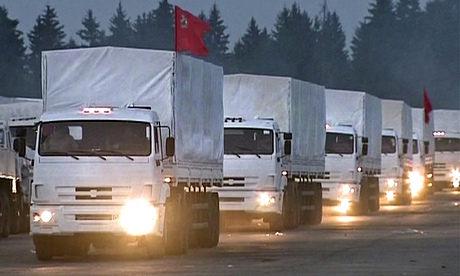
Russian convoy approaches Ukrainian Border

A Russian convoy of 280 military trucks carrying 2,000 tonnes of water, food and other humanitarian aid is making its way towards the Ukrainian Boarder. Kiev reiterated that the convoy could not cross the border until Ukrainian authorities had cleared its cargo.

The humanitarian aid will be delivered to the Luhansk region in eastern Ukraine, which is mostly held by Separatists Forces. Ukraine’s government is sceptical over Russia’s intentions to provide humanitarian aid. Some officials fear that this move could be disguising a Russian plan to invade Eastern Ukraine.


Russian military vehicles supposedly in support of the aid convoy have crossed the Ukrainian border. The aid convoy has remained at the border. A convoy of 23 armoured personnel carriers, supported by fuel trucks and other logistics vehicles crossed the border on Thursday night. Russia has so far denied any military involvement with separatist rebels in Ukraine. 

Monday, 11 August 2014

What's in the Headlines?


Scottish Independence 

On 18th September voters in Scotland will be asked "Should Scotland be an independent country?" A poll from the Scottish Daily Mail newspaper said 50 percent of respondents planned to vote against independence. This is the highest percentage of respondents against Scottish independence since February. The spike in UK supporters has been attributed to the Tuesday debate between Alex Salmond of the pro-independence campaign and Alistair Darling of the Better together campaign. Salmond did not have an adequate response to how an independent Scotland proposed to keep the pound. British government have made it clear that there would be no currency union between an independent Scotland and the rest of the UK.

Republican and Democratic members of the United States Congress have joined forces to encourage Scotland not to vote for independence referring to the ‘special relationship’ held between the United States and the United Kingdom. Republican congressman Ed Royce told Huffington Post that “It is crucial for both our nations to continue our close cooperation on key diplomatic, security, economic, and human rights concerns. A strong, unified United Kingdom has been a leader in the world and I look forward to continuing our valuable partnership." Barack Obama has also shown his support for the UK when he said he wanted to see Britain remain “united”.

Friday, 8 August 2014