Pages

Showing posts with label Russia. Show all posts

Friday, 17 October 2014

What's in the Headlines?


Fall in crude prices may push Russia into a recession

Russia's ruble currency has hit yet another record low on the back of plummeting oil prices. The price of crude oil has fallen 15% in the past three months and is at its lowest in four years. Higher output coupled with weaker demand from China and Europe has driven the price of crude down to $85. The US also now produces 65% more oil than it did five years ago following the increase in shale production. Russia obtains more than half its budget revenue from oil and gas, making its economy vulnerable to oil price changes.

On Wednesday Russia's central bank announced that it would sell $50 billion in foreign currency auctions, this move would help the banking sector pay back its dollar and euro debts and try to ease the ruble's volatility. The central bank has already spent almost $7 billion this month propping up the ruble.

Timur Nigmatullin, a macroeconomic analyst at Investcafe, argued that relatively high oil prices in the first half of the year, when prices were above $100 a barrel, would compensate for the lower prices now. Nigmatullin believes that the government would seek to mitigate the country’s worsening economic situation by borrowing, reducing expenditures and spending money from the reserve fund built up when oil prices were higher. But all these have negative effects, notably rising debt servicing costs and reduced popularity for the government, he said.


Economists have warned that if the oil price does not improve, Russia could face a recession in 2016 or even earlier. Russian recession may impact Putin’s popularity with the country’s business elite. Konstantin Sonin, a professor at the Higher School of Economics, said the falling oil price would lead to spending cuts that could set off alarm bells among business leaders. "The elite is now realizing what these achievements cost," Sonin said, referring to Putin's annexation of Crimea and support for the separatist state in eastern Ukraine.

Monday, 15 September 2014

What's in the Headlines?


Russia steps up military presence in the Arctic 

Six Navy ships, including the anti-submarine destroyer, two landing ships and support vessels, have set off for the New Siberian Islands, where an abandoned military base under reconstruction. The base was abandoned almost three decades ago and was reopened last year as part of Russia’s military build-up in the Arctic.

“The Arctic plays a very important role from the point of view of assuring security . . . because of that, first strike American nuclear submarines are concentrated there not far from the coast of Norway – the flight time of their missiles to Moscow is 15 to 15 minutes. But a significant portion of our naval submarine forces are there too.” President Vladimir Putin said in a speech to the Seliger patriotic summer camp.

The Canadian Prime Minister, Stephen Harper, has expressed his concerns about the growing military presence of Russia in the Arctic region. Though the Russia can be described as operating within international rules, Harper was clear that there can be no complacency about it. There have been reports of a fleet of nuclear-powered Russian submarines and icebreakers are patrolling the waters, and that Russian planes had transgressed the boundaries of Canadian airspace many times. Prime Minister Harper described Canada's position as being cautious. 


Russia’s Foreign Minister Sergey Lavrov dismissed Canadian accusations as “nonsense”.“We have said many times that we will only act within the framework of international law [in the Arctic], as we have always done and are going to do in the future,” Putin said.

Monday, 8 September 2014

What's in the Headlines?


Ukraine’s ceasefire is close to collapsing 

Shelling and gun fire has erupted in Mariupol and city of Donetsk in eastern Ukraine on Sunday night. This comes after a Friday ceasefire agreement was reached in Minsk. More than 2,600 people have been killed since the conflict began in April. A battalion of Ukrainian fighters said that Grad rockets had been fired at its positions destroying at least one vehicle and setting a fuel station ablaze.

Separatist forces and Russian troops have been accused of targeting Ukrainian tanks just outside of the city. Both sides have blamed each other for violating the ceasefire. Tensions remain high in the region as Russian troops remain in the area, a claim supported by NATO. Military officials in Kiev speculate that the number of Russian troops still in Ukraine could be between 3,000 and 4,000.


On Saturday exercise Steadfast Javelin II was staged in Latvia. The exercise simulates a deployment of NATO forces and equipment in a crisis situation. NATO members and allied eastern European nations fear Russia could invade other Baltic countries and use the defence of Russian speakers a justification, like we saw in Crimea. In total, 2,000 soldiers from nine nations will be involved and further exercises will be carried out across five countries - Germany, Estonia, Latvia, Lithuania and Poland. Further exercises in Germany, Norway, Ukraine, and Poland are scheduled for autumn.

Friday, 5 September 2014

NATO Summit 2014


Newport, the third-biggest city in Wales, is this year’s home for the annual NATO summit. Barack Obama, David Cameron and 59 other world leaders will convene in Newport’s Celtic Manor Hotel.
Anti-war protesters were welcomed by the police and were appreciated for carrying out mostly peaceful demonstrations. Memories of violence from previous NATO summits meant police were not taking any chances. Metal barriers were used to prevent protesters from reaching the Celtic Manor resort, and police greatly outnumbered protesters.

An armoured personnel carrier, a tank and an F-35 life-sized model were on display in the Celtic Manor golf resort. A Ministry of Defence (MoD) spokesman said that the displays were intended to showcase British defence capability as well as the country's defence industry.

Eastern European NATO members, including Poland, have appealed to NATO to permanently station troops on their territory to deter possible Russian attack. But not all NATO members agreed with the idea. This is thought to be because of expenses involved and this move would likely breach a 1997 agreement with Russia under which NATO committed to not permanently station large combat forces close to the Russian border. Leaders have agree instead to provide caches of military equipment and resources, in eastern NATO countries with bases ready to receive the rapid reaction force in times needed.

NATO's top official accused Moscow on Thursday of attacking Ukraine, and escalating the conflict. France is to suspend delivery of a state-of-the-art Mistral warship to Russia in protest at Moscow's continued role in unrest in eastern Ukraine. Speaking on the side lines of a NATO summit in Wales, Poroshenko said the ceasefire would be conditional on a planned meeting going ahead in Minsk on Friday of envoys from Ukraine, Russia and Europe's OSCE security watchdog. Poroshenko "At 1400 local time (12:00 noon BST on Friday), provided the (Minsk) meeting takes place, I will call on the General Staff to set up a bilateral ceasefire and we hope that the implementation of the peace plan will begin tomorrow," he told reporters. Oleg Tsaryov, a senior rebel official “in the past we had some ceasefire agreements Poroshenko didn't honour"

Prime Minister David Cameron has warned fellow NATO leaders that they must not pay the requested ransoms to terrorist kidnappers. It comes after he said Britain will not pay a ransom for the UK hostage who Islamic State extremists (IS) are threatening to kill. IS are threatening the life of British aid worker David Cawthorne Haines who has been taken hostage. Nato Secretary General Anders Fogh Rasmussen said: "I do believe the international community as a whole has an obligation to stop the Islamic State from advancing further."


How to stabilize Afghanistan when NATO forces leave at the year's end will also be up for discussion at the summit. Officials have commented that NATO leaders will set up a "spearhead" rapid reaction force, potentially including several thousand troops, that could be sent to a hotspot in as little as two days. 

Monday, 1 September 2014

What's in the Headlines?


Poroshenko fears the Ukraine conflict is reaching “the point of no return.”


Herman Van Rompuy, European Council President the European Union has given Russia one week to reverse course in Ukraine or face new sanctions. Western leaders say there is clear evidence of regular Russian military units operating inside Ukraine with heavy weapons. Russia denies that its forces have illegally crossed into Ukraine. NATO claimed on Thursday that Russia had sent air defence systems, artillery, tanks and armoured vehicles as well as 1,000 troops to support pro-Russia separatists.

Ukrainian President Petro Poroshenko said "We are very close to the point of no return". German Chancellor Angela Merkel is hoping to seek a diplomatic solution to the issue and sees no military solution to the conflict. Poroshenko, visited Brussels to urge the EU to take tougher steps as the sanctions imposed by the west seem to do little to halt the advance of Russian forces. Poroshenko will travel to the NATO summit in Wales this week to meet the US president, Barack Obama, to possibly convince the alliance to take more practical action.

Friday, 15 August 2014

What's in the Headlines?


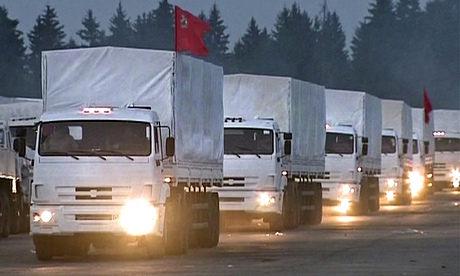
Russian convoy approaches Ukrainian Border

A Russian convoy of 280 military trucks carrying 2,000 tonnes of water, food and other humanitarian aid is making its way towards the Ukrainian Boarder. Kiev reiterated that the convoy could not cross the border until Ukrainian authorities had cleared its cargo.

The humanitarian aid will be delivered to the Luhansk region in eastern Ukraine, which is mostly held by Separatists Forces. Ukraine’s government is sceptical over Russia’s intentions to provide humanitarian aid. Some officials fear that this move could be disguising a Russian plan to invade Eastern Ukraine.


Russian military vehicles supposedly in support of the aid convoy have crossed the Ukrainian border. The aid convoy has remained at the border. A convoy of 23 armoured personnel carriers, supported by fuel trucks and other logistics vehicles crossed the border on Thursday night. Russia has so far denied any military involvement with separatist rebels in Ukraine.